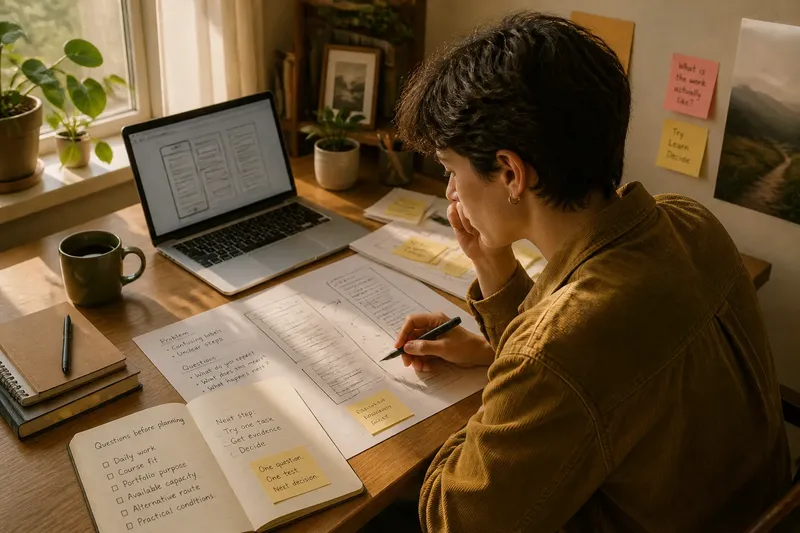
Compare Possible Directions with a List, Map or Scenario
Compare possible directions with a list, branching map or scenario sketch, then see which format makes the real trade-offs easier to examine.

To compare possible directions, match the format to the shape of the choice: use a list for distinct alternatives, a branching map for linked decisions, and a scenario sketch for an option that is hard to picture. Each gives you a different view of the same question; none can tell you which future to choose.
What are you comparing?
Begin by writing the decision in one sentence. “Should I explore community arts work or stay in my current field?” is easier to work with than “What should I do with my life?” because it names the alternatives without pretending to settle every later choice.
Then notice what is making the decision difficult. If the candidates blur together, compare them side by side. If one choice leads to several others, draw the connections. If a promising route feels abstract, describe an ordinary day along it.
- If you have a few distinct candidates: make a short list; if the list keeps growing, group similar options before comparing them.
- If a choice opens different follow-on decisions: draw a branching map; if the branches do not affect your present choice, leave them out.
- If you cannot picture the routine behind an option: write a scenario sketch; if key details are unknown, mark them as questions rather than filling them in.
- If “do nothing for now” is a genuine alternative: include it; if it is only a way to avoid looking at the choice, name what you would revisit and when.
- If you are comparing options using different standards: choose shared comparison prompts; if a prompt matters to only one route, keep it as a separate note.
- If the decision concerns specialist health, money, legal or safety matters: use the format to organise questions; if professional judgement is needed, consult a suitably qualified person.
Choose the simplest format that makes the current question clearer. More structure is useful only when it reveals something the simpler view hides.
When does a short list help?
A short list is best when the options are already distinct and you want to compare them using the same prompts. Write each option on its own line, then add a few considerations that matter to this decision, such as everyday tasks, working relationships, learning demands or practical constraints.
For a possible change in work, you might list “stay in my current role”, “seek a related role” and “explore a different field”. If two options turn out to mean nearly the same thing, combine them; if one depends on a prior choice, note that connection and consider a map.
A list can flatten relationships, though. It is a useful comparison surface, not a picture of how one decision might lead to another.
When should you draw a branching map?
Use a branching map when choices split into further decisions or depend on what happens first. Put the decision you face now at the top or left, draw a branch for each plausible route, and add another fork only if it could change what you choose.
For example, changing fields might involve exploring a course, applying for an entry-level role or trying a related project alongside current work. A course route could then depend on subject or format; the project route might depend on finding a suitable brief. Label branches as decisions—such as “ask about a part-time course”—rather than outcomes you cannot directly choose.
If the map gets crowded, remove consequences that do not affect the decision in front of you. A clear map shows the next fork; it does not need to contain every possible future.
When is a scenario sketch more useful?
A scenario sketch helps when an option sounds appealing but remains vague. Describe an ordinary slice of a possible week: the tasks, setting, people involved and demands that might compete for your attention.
Keep assumptions visible. If you do not know how much of a role involves administration, write that as a question to check rather than treating your imagined routine as fact. A vivid scene can reveal what you want to ask about; it cannot establish what the work is actually like.
Say you are considering a move from office work into community arts. You start with the known detail that the option involves working with a community arts organisation, then sketch a possible day that includes preparing materials, speaking with participants and handling administration. You mark the balance between those tasks as unknown, ask someone in the field how their week is usually divided, and compare their answer with your sketch. The result is a more specific trade-off to consider: how much participant contact you want alongside planning and administration.
Which format fits a common comparison problem?
How do I compare too many possible directions?
List the candidates, then group options that answer the same underlying question. If the remaining choices lead to different follow-on decisions, map those forks instead of adding more lines to the list.
How can I tell what depends on an earlier choice?
Start a branching map with the decision you can make now and add only the immediate next choices. If a branch depends on information you do not have, mark it as unknown and leave it open.
What should I do when an option feels exciting but vague?
Sketch an ordinary day, including routine work as well as the appealing parts. If the scene relies on details you cannot verify, turn them into questions for a conversation or a closer look at the setting.
Can I combine a list, map and scenario sketch?
Yes, if each format answers a different question: the list sorts candidates, the map shows consequential forks, and the sketch makes daily demands easier to imagine. If one format already clarifies the choice, stop there.
How can you make a fair comparison?
Separate what you know from what you expect. “This route involves regular contact with clients” is a detail to verify; “I might find that draining” is a personal prediction. Both belong in a comparison, but they should not be treated as the same kind of claim.
Use prompts that reflect your actual priorities, such as the tasks you want more of, the demands you can accommodate and the questions that remain unresolved. Avoid forcing every consideration into a single score: a tidy ranking can conceal a trade-off that deserves a closer look.
If a decision involves health, money, legal obligations or safety, these formats can help you organise your questions, but they are not a substitute for qualified advice where it matters.
What is the useful result of comparing possible directions?
A comparison is useful when it clarifies what you would need to decide next, not when every box is filled. You might discover that two routes share the same uncertainty, or that one apparently attractive option depends on a detail you can check before making a larger commitment.
Write down the unresolved question and what information would help answer it. That keeps your list, map or scenario sketch connected to the real choice—and makes it easier to revise your view when new details arrive.